Providoor · Investigation
What Happened to Providoor?
The pandemic-era restaurant-delivery phenomenon collapsed, was relaunched under a new company and became a central case study in a new business book. BLUNT.news matched 1,196 reviews across two systems and found that the matched company-level Okendo set contained none of the one- or two-star reviews in the broader record but almost all of its four- and five-star reviews. The page that later promoted 1,530 reviews at 4.6 stars now redirects to an older article.
In this investigation
During lockdown, Providoor made an impossible promise feel ordinary: the restaurant could come to you.
Neil Perry, Shane Delia, Supernormal, Maha and other names from Australian dining arrived at suburban front doors in boxes. Customers finished the dishes at home, followed reheating instructions and got a version of the night out they were not allowed to have.
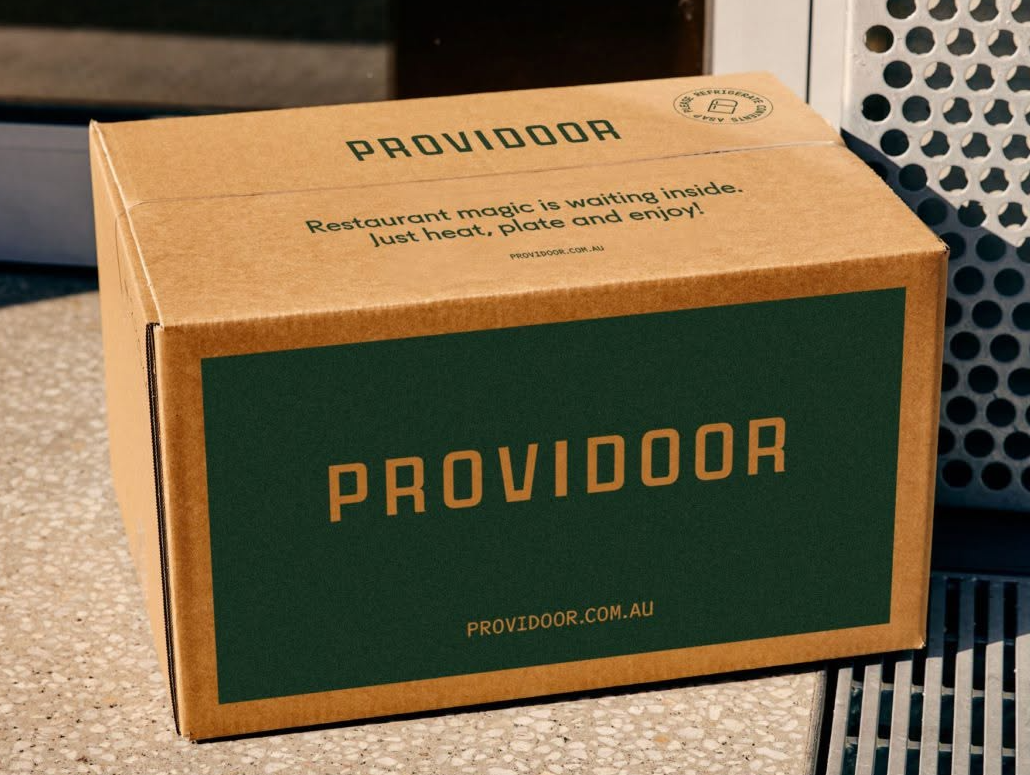
Providoor became more than a delivery service. It was emergency infrastructure for restaurants, a lockdown ritual and proof that Australians would pay to bring a more ambitious version of hospitality into their homes.
Then the world reopened.
On 28 April 2023, the original Providoor ceased trading and entered liquidation. The company said it had delivered more than one million meals. Its closure affected about 50 participating restaurants and 16 full-time employees, while customers holding vouchers or paying for future orders faced the prospect of joining the creditor queue.
Six months later, the name came back.
Under new ownership, Providoor relaunched in October 2023 with a different model: chef-branded meals designed to be stored, reheated and delivered over a much wider window than the original fresh restaurant marketplace. The relaunch was promoted with names including Manu Feildel, Silvia Colloca, Anna Polyviou, George Calombaris, Luke Nguyen and Matt Preston. Media were told meals would be prepared in four Sydney kitchens, with further expansion planned.
The Providoor name had survived.
But what, exactly, had survived: the company, the service, the chefs, the reputation or simply the name?
That question became more consequential in August 2026, when Providoor appeared as the proof point in a new management book.
Luke Girgis’s Death to the Org Chart presents Providoor as a striking transformation and evidence for his management method.
I had seen versions of these claims before. I had also worked inside another business now appearing in Girgis’s authority story: The Brag Media, where I served as COO before later holding the same role at Vinyl Group.
Some of the shorthand did not match what I remembered. But businesspeople compress their histories every day, and that alone did not justify an investigation.
Then the claims became credentials.
Providoor was no longer just a chapter in Girgis’s working life. It was “operator evidence” for a book, an executive audit and Operationalise, the consulting practice applying the method described in the book. Girgis’s current website prominently presents the movement from A$400,000 in monthly losses to breakeven and from 30 staff to three as proof that the method works.
So I started checking the record.
What Girgis says happened at Providoor
In Death to the Org Chart, Girgis says:
- Providoor was losing approximately A$400,000 per month and had more than 30 staff;
- the initial objective was to reach breakeven within six months, but he says it took approximately two years;
- revenue stayed flat while the cost base collapsed, the food improved and customer satisfaction reached an “all-time high”;
- Providoor reached breakeven with three staff rather than more than 30;
- he then handed the CEO role to successor Ryan Parker, moved into an advisory role and credited Parker with taking the company further.
Taken together, those claims describe an extraordinary operating change. If Providoor moved from losing approximately A$400,000 a month to breakeven while revenue remained broadly flat, most of the improvement would have had to come from the cost base. At the starting run-rate, the claimed loss was equivalent to approximately A$4.8 million a year.
Girgis’s account is therefore of a business that eliminated an approximately A$400,000 monthly loss, reduced staffing from more than 30 people to three, maintained revenue, improved its food and, in his account, achieved the highest customer satisfaction in its history.
BLUNT has not been provided the underlying revenue, cost, payroll or customer-satisfaction records required to independently verify that account.
DEATH TO THE ORG CHART / PROVIDOOR CLAIMS
The turnaround account, in the book
01 · THE START · Kindle, Location 190.
02 · THE CLAIMED TURNAROUND · Kindle, Location 204.
03 · THE HANDOVER · Kindle, Location 226.
The Kindle interfaces are retained to preserve source provenance. The passages are presented as the author’s account, not independently verified financial or payroll records.
Which Providoor came back?
The distinction between the old and new Providoor is not something BLUNT has invented. The current business makes the distinction itself.
Customers holding vouchers issued by the collapsed operation are told those vouchers cannot be redeemed because the relaunched Providoor is a completely new company with a different business model and operations. The current site says the former company’s financial liabilities did not transfer when the brand was purchased.
That is a normal and important corporate distinction. Buying a brand from a collapsed business does not automatically mean buying its debts.
The line becomes harder to see when the subject is reputation.
The review history associated with the relaunched Providoor reaches back years before the current company began trading. In the Reviews.io export analysed by BLUNT, almost half of the dated reviews were written before the October 2023 relaunch. Hundreds of those pre-relaunch reviews also appeared in the company-level Okendo records analysed below.
Legally, an old voucher and an old review are not the same thing.
To a customer deciding whether the business is reliable, however, a single review total can make two materially different operations look continuous.
The timing matters because the review picture grew particularly complicated after Girgis arrived.
Girgis publicly announced in August 2024 that he had joined Providoor as chief executive, saying he had already spent approximately two months with the company. The announcement came soon after his departure from The Brag Media.
That chronology matters. Providoor had already been acquired and relaunched under Sam Benjamin’s ownership group before Girgis joined. His claimed achievement is the operating turnaround he says followed his arrival, not the 2023 acquisition or relaunch.
By Christmas, Providoor was several months into his tenure.
And customers were beginning to describe serious problems.
Two versions of Christmas
Girgis’s claim that customer satisfaction reached an “all-time high” is particularly important in light of the public review record. Public reviews may not be the same metric as an internal CSAT score, so they do not by themselves disprove his statement. They do not independently support it either.
Reviews.io recorded 39 Providoor reviews averaging 3.67 stars in November 2024, 27 averaging 3.19 in December and 41 averaging 2.76 in January 2025.
The reviews described concrete problems.
On 9 January, Patrick Walsh gave Providoor one star and wrote that its heavily promoted slow-roasted porchetta had “ruined half our Xmas dinner”. He described the meat as chewy and fatty.
Another customer said a Christmas bundle promoted as feeding eight included quantities they believed were sufficient for four.
On 30 January, Carmen Cairns gave one star and wrote: “Did not get any of my Christmas food.” She said the order had been refunded but the delivery charge retained, and described customer service as non-existent.
Other low-rated reviews from the period described late or missing orders, thawed or damaged meals, absent replies, incorrect items and refunds customers said had not arrived.
An independent platform was recording a similar mood. ProductReview carried seven December 2024 reviews averaging approximately 1.71 stars and five January reviews averaging 1.4. Its headlines included “Thawed meals”, “Food was ordered and never delivered”, “Christmas bundle issues” and “Missing and incorrectly delivered items”.
ProductReview is self-selecting. A customer who goes looking for an independent review platform may be more motivated by a bad experience than someone invited to review a completed purchase. Its rating should not be treated as directly interchangeable with a merchant-solicited or verified-buyer system.
But ProductReview was not the only source showing deterioration. Reviews.io was showing it too.
The matched company-level Okendo set moved differently: 4.80 in November, 4.92 in December and 4.44 in January. In December, the broader Reviews.io average fell while the matched company-level set rose.
BLUNT DATA ANALYSIS / CHRISTMAS 2024
The matched company-level Okendo set is a subset of Reviews.io, not a separate customer sample.
| Month | Reviews.io | Matched company-level Okendo set |
|---|---|---|
| November 2024 | 39 reviews, 3.67 | 25 reviews, 4.80 |
| December 2024 | 27 reviews, 3.19 | 12 reviews, 4.92 |
| January 2025 | 41 reviews, 2.76 | 18 reviews, 4.44 |
At first, the obvious explanation was that the two platforms were sampling different customers.
The data showed otherwise.
Which reviews made it into the company-level set?
BLUNT analysed 1,500 Reviews.io records and 2,248 Okendo records associated with Providoor and its individual meals.
Within the Okendo export were 1,196 company-level records whose product field was simply “Providoor”. This article refers to those exact-matched records as the matched company-level Okendo set. Separate Okendo records attached to individual meals are described as product-level Okendo reviews.
Each of those 1,196 company-level records matched a Reviews.io review using the exact timestamp, down to the second, and the same rating.
The matching keys were unique in both datasets. This was not a fuzzy comparison between similar dates or ratings, and it was not a coincidence produced by duplicate records.
The matched company-level Okendo set was a subset of the Reviews.io record. Both sets contained customer reviews. The difference was which reviews appeared in the company-level set.
The answer was visible in the star ratings.
BLUNT DATA ANALYSIS / 1,196 EXACT MATCHES
| Rating | Reviews.io | Also present in matched company-level Okendo set |
|---|---|---|
| 1 star | 86 | 0 |
| 2 stars | 82 | 0 |
| 3 stars | 125 | 29 |
| 4 stars | 211 | 197 |
| 5 stars | 996 | 970 |
The pattern remained after limiting the analysis to reviews written after the new Providoor launched. The post-relaunch Reviews.io record contained 78 one-star reviews and 75 two-star reviews. None appeared in the matched company-level Okendo set. By comparison, that set contained 128 of the 142 four-star reviews and 355 of the 381 five-star reviews.
The Christmas period made the effect especially clear.
Across December 2024 and January 2025, Reviews.io contained 68 reviews averaging approximately 2.93 stars. Thirty-four were one- or two-star reviews.
Not one of those 34 low-rated reviews appeared in the matched company-level Okendo set.
In December, the matched company-level set contained 11 five-star reviews and one four-star review. At the same time, Reviews.io was recording customers saying their Christmas food never arrived or arrived late, and that meals had damaged part of an important family occasion.
The result was a much more positive company-level average at the same time the broader customer-review average was falling. The issue was not whether the positive reviews were genuine. It was which customer reviews appeared in the company-level set.
Okendo’s review-moderation tools allow merchants to publish or reject reviews, leave them pending and configure automated moderation rules. Imported reviews can likewise carry approved, pending or rejected status.
The captured export does not contain a complete administrative audit trail. It does not show whether Providoor used those controls, who made any selection decisions or why, or prove that every captured company-level record appeared on every version of the live site.
What BLUNT can establish is the selection outcome: none of Reviews.io’s one- or two-star reviews appeared in the matched company-level set, while almost all four- and five-star reviews did.
That caveat matters. So does the resulting pattern.
The ACCC says a business may mislead consumers if it suppresses or edits negative reviews or removes genuine negative reviews, and says businesses and review platforms should clearly disclose their publication and moderation policies. BLUNT is not concluding that Providoor breached Australian Consumer Law. That would require findings about conduct and context beyond the datasets reviewed here. The regulator’s guidance explains why consumers are entitled to know how a review picture has been assembled.
The most direct question for Providoor is simpler: How did this selection pattern occur?
Which Providoor earned the stars?
The data raises a second question.
Of the 1,500 Reviews.io reviews analysed by BLUNT, 723, or 48.2 per cent, predate the current Providoor’s October 2023 relaunch.
Those pre-relaunch reviews average approximately 4.76 stars.
The 777 reviews written after the relaunch average approximately 3.87.
BLUNT matched 688 reviews from the old Providoor period into the matched company-level Okendo set.
That historical reputation was valuable. It came from the lockdown-era service: a fresh restaurant marketplace involving different kitchens, restaurant partners, delivery arrangements and a different operating company.
The current operation says old financial liabilities did not follow the brand into the new company. Yet a large body of old customer goodwill did.
That does not automatically make the reviews irrelevant. Consumers may reasonably care about a brand’s history, and the current business may have lawfully acquired data or review assets along with the name.
The question is whether a customer shown a single total is given enough context to understand that a substantial portion was earned by a different business selling a materially different product.
This continuity problem becomes sharper when Providoor describes itself.
Its current voucher notice stresses the break between old and new. But a company-authored article published in March 2026 described Providoor as an Australian company operating since 2020 and used feedback accumulated over years of operation as evidence that the product works.
In one context, the two Providoors are separate.
In another, the history is continuous.
Then Providoor reviewed Providoor
The last record in the matched company-level Okendo set is dated 21 November 2025. Product-level Okendo reviews continued: 66 in December and 24 in January, then one in February, none in March or April, four in May, seven in June, four in July and 11 through 11 August. BLUNT’s Reviews.io export contains no records after 31 January 2026. ProductReview recorded isolated negative reviews through July.
Review volume is not a proxy for sales. Platforms and invitations can change, seasonality can distort activity and many customers never leave feedback. The flow did not stop, but it became fragmented and much smaller than the Christmas peak. A historical aggregate such as “1,530 reviews averaging 4.6 stars” therefore provides limited evidence of current customer satisfaction.
During this period, Providoor began publishing its own review articles.
On 12 February 2026, the “Providoor Editorial Team” published Providoor Reviews 2026: Is It Worth It? Honest Assessment.
It promised “real ratings, real prices, real verdict” and presented individual product scores including:
- a lamb shoulder rated 5.0 from 40 reviews;
- Italian meatballs rated 4.8 from 32;
- a coconut prawn curry rated 4.6 from 51;
- butter chicken rated 4.2 from 39.
The piece said: “These are not inflated numbers.” Its counts closely track the captured product-review data: 40 lamb-shoulder reviews averaging 4.975, 32 meatball reviews averaging 4.781 and 39 butter-chicken reviews averaging 4.205.
On 2 March, the Providoor Editorial Team published Providoor Review 2026: 1,530 Reviews. Is It Worth It? It called itself an honest assessment, promised no marketing copy and reported 1,530 reviews averaging 4.6 stars as evidence that the product worked.
BLUNT could not reproduce that figure from the 1,500 Reviews.io records, whose simple arithmetic average is approximately 4.30.
Even if the additional 30 reviews needed to reach 1,530 were all perfect five-star ratings, the combined average would be approximately 4.31, still well below 4.6.
There may be an ordinary explanation. The calculation could use a different source set, combine company and product reviews, apply platform-specific weighting or omit records under a stated methodology.
Providoor has not publicly identified the review universe or calculation.
FOUR DIFFERENT REVIEW UNIVERSES
Which reviews produced 4.6?
- All Reviews.io analysed
- Full dated export
- 4.30
- 1,500 reviews
- Reviews.io after relaunch
- October 2023 onward
- 3.87
- 777 reviews
- Reviews.io at Christmas
- December 2024 + January 2025
- 2.93
- 68 reviews
- Providoor promoted figure
- Company-authored article
- 4.6
- 1,530 reviews
The sequence is important:
- the broader Reviews.io record deteriorated sharply through Christmas 2024;
- the matched company-level Okendo set remained dramatically more positive, containing almost all four- and five-star Reviews.io reviews while containing none of its one- or two-star reviews;
- the last captured company-level review was dated 21 November 2025, while highly rated product-level reviews continued;
- Providoor began publishing company-authored review articles, including the unexplained 1,530-review, 4.6-star aggregate;
- that March article is no longer served at its original URL, which now permanently redirects to the older February review.
BLUNT preserved the March article while it was live on 20 August 2026 at approximately 5:07pm AEST. The article promoted 1,530 reviews averaging 4.6 stars.
When BLUNT checked the original URL again in the early hours of 22 August, the March article was no longer being served at that address. The URL returned an HTTP 301 Moved Permanently response through Shopify’s store redirect system to Providoor’s separate 12 February review article. The redirect response included X-Redirect-Reason: shop_redirect, and the February destination returned HTTP 200.
The March article was also absent from Providoor’s current sitemap and blog feed. BLUNT preserved the redirect chain in response headers, screenshots and a HAR file from the same Chromium session.
BLUNT has not established precisely when the redirect was created, who or what created it, why it was introduced or whether the change was connected to BLUNT’s enquiry.
BLUNT sent Providoor a supplemental enquiry at 3:56pm on 21 August specifically asking for the source and calculation behind the 1,530-review, 4.6-star figure. That enquiry fell within the period between BLUNT’s last verified live capture of the March article and its first verified observation of the permanent redirect.
Providoor did not provide a substantive response to BLUNT’s questions about when or why the article and redirect were changed.
What Providoor is now
The current Providoor website is live and accepting orders. It advertises more than 90 dishes across eight chefs, an A$80 minimum order and delivery to Sydney, Melbourne, Brisbane and regional areas along the east coast. Its FAQ says meals are prepared and dispatched from facilities on the east coast, without identifying each current production site.
That is different from the relaunch story in October 2023, when four Sydney kitchen locations were publicly named and further kitchens in Melbourne and Brisbane were planned. BLUNT has not independently established which of those sites remain in use, where each current meal is produced, or the present contractual status of every chef displayed on the site.
The public workforce chronology is less linear than the book’s “30 to three” shorthand suggests. LinkedIn’s historical company insights, which are associated-profile data rather than audited payroll records, show approximately 13 Providoor-associated profiles around the August 2024 CEO appointment, approximately 14 in early 2025 and double-digit visibility through much of that year. The sharpest visible contraction appears in late 2025 and early 2026, with approximately five profiles in the captured 2026 company data.
LINKEDIN-ASSOCIATED PROVIDOOR PROFILES
A smaller visible workforce
Double-digit visibility through much of 2025; sharp contraction late 2025 / early 2026
- Around Aug 2024
- ≈13
- Early 2025
- ≈14
- By 2026
- ≈5
The public platform indicator supports substantial contraction. It does not identify employment type, hours, contractors, advisers, stale profiles or shared group resources.
LinkedIn can include contractors, advisers, stale profiles and people splitting time across related companies. This does not disprove a three-person operating team. It does leave important questions about when the claimed three-person state was reached, what Girgis meant by “staff”, and whether that position had been achieved and sustained before the leadership handover.
The public record supports substantial contraction.
What the public record does not independently establish is the financial result that turns that contraction into the turnaround described in the book.
BLUNT has not seen records establishing:
- what accounting measure produced the A$400,000 monthly-loss figure;
- which months it covered;
- when breakeven was first achieved;
- whether breakeven was sustained;
- whether revenue remained flat;
- what internal measure reached an all-time high;
- who was counted among the “three staff”.
“Three staff” could mean three direct employees, three full-time equivalents, three corporate staff or three people excluding kitchen labour, contractors and shared group resources. Those are materially different operating claims.
Girgis’s appointment as chief executive received a clear public announcement in August 2024. BLUNT has not identified an equivalent prominent public announcement marking his departure from the CEO position. His book says he handed Providoor to successor CEO Ryan Parker and moved into an advisory role, and credits Parker with taking the company further.
The relevant question is not why Girgis left. It is what condition Providoor was in when Parker took over, and whether the claimed breakeven-on-three-staff result had already been achieved and sustained.
Those questions may have straightforward answers, but none were supplied before publication.
When the claims became credentials
Without the book, much of this would be corporate archaeology.
Businesses shrink. Review systems change. A brand acquired from liquidation carries some parts of its history forward and leaves others behind.
Death to the Org Chart changes why those details matter.
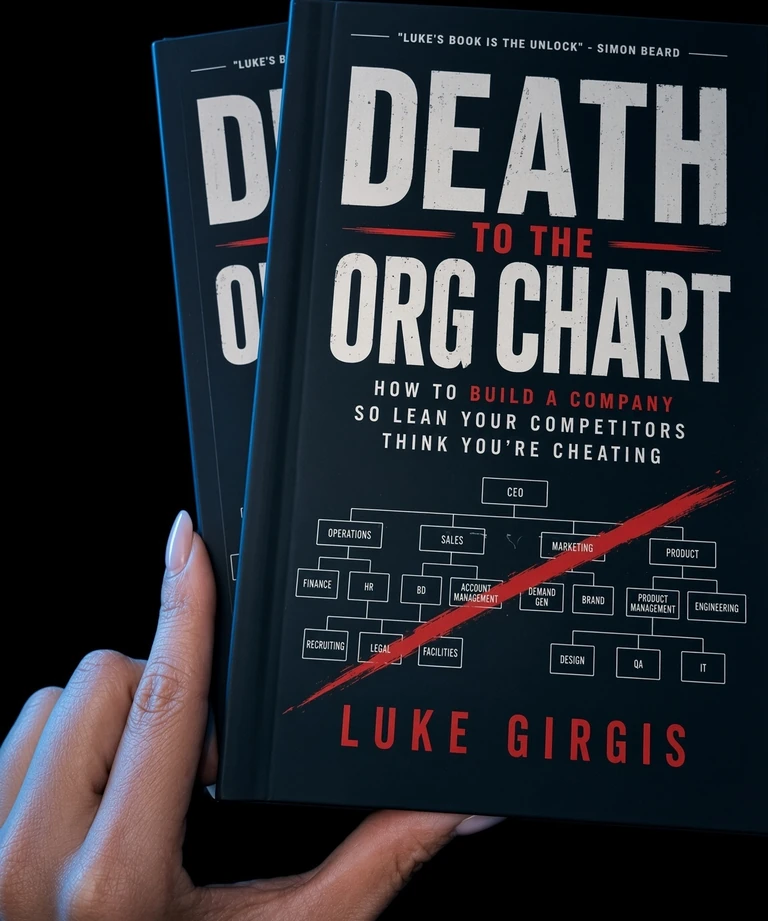
Near its beginning, the book directs readers to a free executive audit. Its later sections describe Operationalise as the consulting practice that applies the method developed across Girgis’s businesses. His website presents Providoor’s claimed A$400,000-a-month turnaround and 30-to-three staff reduction as “operator evidence”, alongside other claimed savings and avoided hires.
BOOK / OPERATIONALISE COMMERCIAL PATH
From claimed result to commercial application
The book directs readers to a free executive audit.
Later, it identifies Operationalise as the consulting practice applying the method.
- Book
- Executive audit
- Operationalise
- Consulting / application
The commercial logic is clear: the claimed result validates the method, and the method is then offered to other businesses.
There is nothing inherently unusual about turning experience into a book or consultancy. But if the outcome is the proof, checking the outcome is part of checking the product.
Providoor is not the only business result used to establish Girgis’s authority.
He also describes building and selling The Brag Media.

I knew that transaction was real. I also remembered that the headline version compressed important detail, so I checked the public filing rather than relying on memory.
Girgis’s current LinkedIn profile describes him as ‘Co-Founder, Rolling Stone + Variety AU (sold 2024)’. He was not a founder of Rolling Stone Australia, which existed decades before him. The Brag Media later relaunched the Australian edition under licence from Penske Media Corporation. The Variety reference is more nuanced: Variety Australia launched during Girgis’s Brag tenure under a separate Penske-Brag licensing arrangement. Vinyl’s 2024 transaction was the acquisition of The Brag Media, not the sale of the Rolling Stone or Variety brands themselves.
Vinyl Group’s December 2023 ASX announcement said its upfront payment for The Brag Media would combine the value paid for the shares with repayment of loans made by shareholders to the business.
After completion, Vinyl’s February 2024 half-year report recorded a final upfront purchase price of A$8,050,792, comprising A$1,291,979 described as equity consideration and A$6,758,813 described as repayment of loans. A further performance payment of up to A$2 million was possible.
Public filings show the transaction components. ASIC records and firsthand reporting provide ownership and payment context.
Vinyl acquired 100 per cent of The Brag Media, but the A$8.05 million upfront figure was not simply the price paid for the shares. Vinyl’s public reporting split the amount into A$1,291,979 in equity consideration and A$6,758,813 in loan repayments. A possible earnout of up to A$2 million was separate.
ASIC records show that a Girgis-linked vehicle held approximately 10 per cent of The Brag Media at the relevant time, while Benjamin-linked interests held approximately 90 per cent.
During my time at Vinyl, I had firsthand visibility of parts of the financing and sale. I saw business records showing that Benjamin-linked entities had advanced substantial loans to The Brag Media. I also attended meetings where Benjamin’s funding of the business was discussed, and heard Girgis say on multiple occasions that Benjamin-linked companies had funded it.
I also heard Girgis describe The Brag Media more than once as a company he had sold for about A$8 million. The public filings and ownership records show why that shorthand needs qualification. Most of the A$8.05 million upfront settlement was loan repayment rather than equity consideration, and the Girgis-linked vehicle held approximately 10 per cent of the company.
I also saw settlement material showing A$119,198, or about A$120,000, directed to Sarayu Company Pty Ltd as trustee for the Sarayu Family Trust, a Girgis-linked vehicle. Girgis signed the document as a director of Sarayu Company.
The A$119,198 directed to the Girgis-linked vehicle was about 1.5 per cent of the A$8.05 million upfront total. The document does not establish that Girgis personally received the money or that it captures every economic benefit to him or related entities. It does, however, put the scale of the headline transaction in perspective.
Taken together, the ownership records, Vinyl’s public accounting and the transaction material I saw make the distinction important. The A$8.05 million headline was a company-level settlement figure that included millions of dollars in loan repayments. It was not A$8.05 million paid to Girgis for his stake.
BLUNT contacted Vinyl Group regarding the transaction and related figures. Vinyl declined to comment.
The point is narrower: a real, complex transaction becomes much cleaner when converted into an entrepreneurial credential.
How a claim becomes the record
While checking the book, I began watching the same achievements move into third-party media.
A claim on somebody’s LinkedIn page is obviously a claim. Put the same claim inside a media article and it changes character. It becomes a source that readers, Google and AI-assisted search can encounter as apparent corroboration.
The underlying evidence may not have changed. The distance between the claim and the person making it has.
One place I could watch that happening was The Music.
Its earlier coverage contained more qualifying context. In June 2024, the publication reported that Girgis had left The Brag Media after a Vinyl review and that personnel changes were expected to produce approximately A$750,000 in annual operating savings. The public reporting reviewed by BLUNT does not establish whether Girgis resigned or was terminated. Later coverage reported both sides of litigation connected with the acquisition. Another interview described problems found in the acquired publishing operation.
In August 2026, its book coverage presented a simpler success story. A feature by Stephen Green described the Brag transaction as “Australia’s most successful music media exit” and Providoor as a major turnaround, using the results to frame Girgis as an operator whose method had worked.
BLUNT asked what independent verification supported those editorial descriptions and whether the earlier reporting had been reviewed before publication.
Green did not provide a substantive response by the publication deadline.
The issue is not that media should never report somebody’s account of their own career. It is that attribution and verification matter when a claim is doing commercial work.
The sequence can become self-reinforcing:
A person makes a claim. A publication repeats it. The publication becomes searchable third-party material. The claim appears externally corroborated. That apparent corroboration strengthens the authority used to market the book or service.
Repetition is not verification. But online, where search and AI increasingly mediate what readers see, it can look very similar.
The launch of Death to the Org Chart offered another example of authority accumulating in public.
Around his 39th birthday, Girgis sent messages asking contacts to buy the book as a birthday present. Early promotion celebrated a position around No. 18 “on the Amazon Charts” and encouraged contacts to help move it higher.
The book subsequently achieved a genuine result: it reached No. 1 in Amazon Australia’s Kindle Business Consulting category and carried Amazon’s No. 1 Best Seller badge.
That achievement was real. It was also category-specific; it did not mean the book was the No. 1 title across Amazon Australia.
There is nothing inherently improper about an author mobilising a network during launch, and BLUNT has no evidence the campaign breached Amazon’s rules or caused the eventual ranking.
The relevance is the loop.
The claimed business result validates the operator. The operator validates the method. The book validates the consultancy. Media and bestseller status then validate the book.
None of those layers substitutes for the evidence underneath the original result.
Back to Providoor
This investigation did not prove that the Providoor turnaround was invented.
It independently established substantial contraction. It found that the matched company-level Okendo set contained none of Reviews.io’s one- or two-star reviews while containing almost all of its four- and five-star reviews. It also found that almost half the review history predated the current company. BLUNT could not reproduce Providoor’s promoted 4.6-star average from the 1,500 Reviews.io records, and documented that the page carrying the claim later redirected to an older article.
The records available to BLUNT do not independently establish the central financial claim: that Providoor eliminated approximately A$400,000 in monthly losses while revenue remained flat, reached sustained breakeven and operated with three staff.
On The Brag Media, the record was similarly more qualified than the headline. Girgis was not a founder of Rolling Stone Australia; Brag later operated the local edition under licence. The Girgis-linked vehicle held about 10 per cent of Brag, and A$119,198 of the A$8.05 million settlement was directed to it. That does not establish Girgis’s total personal benefit.
Those claims may ultimately prove correct. If they do, company records should make the achievement clearer, not less impressive.
The business Australians remember from lockdown, the business relaunched in 2023 and the business now appearing in a management book share one name.
They are not necessarily the same Providoor.
If material evidence or responses arrive after publication, BLUNT will add them to the record with a visible timestamp rather than quietly rewriting what was known at the time.
Right of reply · Questions sent
Right of reply
LUKE GIRGIS: NO SUBSTANTIVE RESPONSE BLUNT put detailed questions to Luke Girgis before publication concerning the claimed A$400,000 monthly loss, the accounting basis and period, breakeven and whether it was sustained, the 30-to-three staffing claim, customer satisfaction, his Providoor tenure and handover, the economics of the Brag Media transaction and Amazon ranking language. No substantive response was received by the publication deadline. BLUNT subsequently asked Girgis to clarify his current LinkedIn description, ‘Co-Founder, Rolling Stone + Variety AU (sold 2024)’, including what he meant by ‘Co-Founder’ given the licensing history of the Australian editions and whether ‘sold 2024’ referred to the sale of The Brag Media. No substantive response was received by the deadline.
SAM BENJAMIN / PROVIDOOR: NO SUBSTANTIVE RESPONSE BLUNT put detailed questions to Sam Benjamin and Providoor before publication concerning the company’s current staffing, production facilities, geographic reach, chef relationships, review provenance, the promoted 1,530-review / 4.6-star figure, the claimed turnaround and Providoor’s condition at the leadership handover. BLUNT subsequently sent Providoor a supplemental right-of-reply request setting out the completed cross-platform review analysis, including the 1,196 exact timestamp-and-rating matches, the star-by-star composition and the Christmas 2024 / January 2025 comparison. No substantive response was received by the supplemental publication deadline. After BLUNT established that Providoor’s 2 March review article was no longer being served at its original URL and that the address now returned a Shopify 301 permanent redirect to the separate 12 February article, BLUNT sent a further enquiry asking when and why the article and redirect were changed, how the redirect was created, whether Providoor continued to stand by the 1,530-review / 4.6-star claim, and whether the change was connected to BLUNT’s enquiry. No substantive response was received by the publication deadline.
STEPHEN GREEN / THE MUSIC: NO SUBSTANTIVE RESPONSE BLUNT put detailed questions to Stephen Green before publication concerning the factual basis for describing the Brag Media transaction as “Australia’s most successful music media exit”, the independent verification undertaken of the Providoor turnaround claims, whether The Music’s earlier reporting was reviewed, and whether the feature involved any sponsorship, contra, commercial arrangement or supplied promotional material. No substantive response was received by the publication deadline.
VINYL GROUP: DECLINED TO COMMENT BLUNT contacted Vinyl Group regarding the Brag Media transaction and related transaction figures. Vinyl Group declined to comment.
If a substantive response or material evidence is received after publication, BLUNT will add it to the record with a visible timestamp.
Sources & method · provenance
Sources and method
BLUNT analysed:
- 1,500 dated Reviews.io records;
- 2,248 Okendo records;
- 98 ProductReview records;
- Providoor’s current public website and company-authored review articles;
- Death to the Org Chart;
- public ASX and ASIC records;
- LinkedIn Premium company insights;
- public posts, screenshots and media coverage;
- firsthand observations from Joel King’s work at The Brag Media and Vinyl Group, where identified in the article;
- right-of-reply correspondence.
For the cross-platform review analysis, BLUNT normalised date and time values to UTC and matched Reviews.io records against the company-level Okendo records using exact timestamp to the second and rating. All 1,196 matches were based on unique timestamp-and-rating keys in both datasets.
The captured Okendo export does not contain a complete moderation audit trail. The analysis therefore establishes the composition of the dataset, not who made each moderation or import decision, the mechanism used, the reason for it or whether every captured company-level record was displayed on every version of the live site.
The datasets do not establish sales, revenue or profitability. ProductReview is self-selecting. LinkedIn-associated employee data is not audited payroll information.